
Page Content.

Facts

History

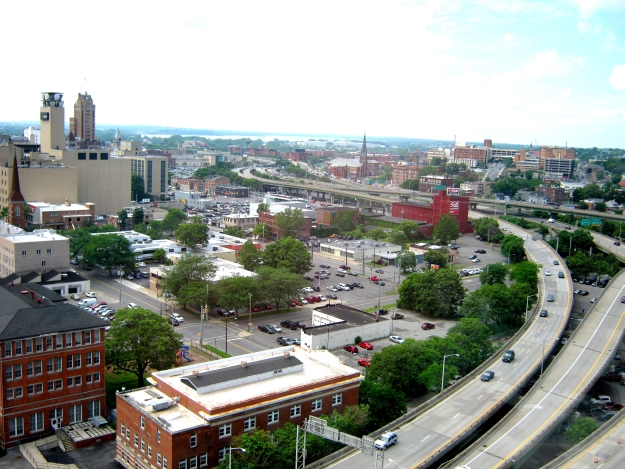
I-81 was built in Central New York during the 1950s and 1960s for two main reasons: to carry through traffic between Pennsylvania and Canada and to bring local traffic in and out of the City of Syracuse.  The highway was the product of a vigorous federal road-building program that included the construction of many miles of interstate highways in every state across the country.

The idea of the proposed highway, particularly through downtown Syracuse, was controversial.  Local residents, business interests, and leaders had differing opinions about the highway's design and location.  Many issues, including economic growth, property taxes, housing, and community development, were divisive.  Ultimately, the decision was made to construct the highway with its current design and alignment and, by the late 1960s, I-81 was completed through Onondaga County.

Role and Function

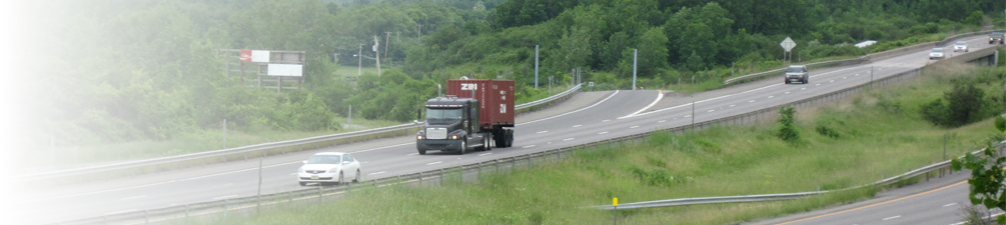
I-81 serves two major transportation functions. First, I-81 is one of the Syracuse metropolitan area’s major commuter corridors. I-81 provides direct access from suburban and rural communities to downtown Syracuse, the city’s hospitals, Syracuse University, and SUNY-ESF. The Greater Syracuse Economic Growth Council reports that five of the region’s 10 largest employers are located adjacent to I-81. Second, I-81 is an important national and international trade route. In terms of long-distance hauling, I-81 provides a major alternative to congested I-95. According to the I-81 Corridor Coalition, it has been estimated that 12% of the United States’ Gross Domestic Product travels on some portion of the I-81 corridor. I-81 also serves as an important connection to the east-west route of I-90.


Current Conditions


Average Daily Traffic (796 kb; approx. download, 0h:1m:53s, 56k modem)

Traffic

Anyone who commutes to work on I-81 realizes that this road carries a large portion of the region’s traffic. Currently, there are approximately 100,000 cars and trucks per day on the most heavily-traveled portion of I-81 in the City of Syracuse. Traffic decreases to approximately 65,000 cars per day at the northern interchange with I-481, and to 40,000 cars per day at the southern interchange with I-481. In comparison, I-690 carries more cars and trucks per day on its most heavily-traveled segment: over 120,000.

Map at right: The traffic volumes on the Syracuse region’s interstate highway network vary from about 25,000 vehicles per day on the more lightly traveled portions of I-481 to over 122,000 vehicles per day on I-690 just east of I-81. These substantial variations in traffic indicate that many drivers use the interstates for relatively short trips. The highest volume on I-81, nearly 99,000 vehicles per day, occurs just north of the I-690 interchange. The highest volume on the viaduct is 88,000 vehicles per day.

Safety

For most of the I-81 corridor, accident rates are below the statewide average for similar interstate systems. However, accident rates from the I-481 interchange north of the city to the I-690 interchange and from the Adams Street exit to the I-481 interchange south of the city are slightly above the statewide average. The accident rate on the viaduct portion of I-81 is more than double the statewide average. Due to its tight curves and narrow shoulders, large portions of the viaduct are difficult for emergency responders.


Interstate Congestion Areas (803 kb; approx. download, 0h:1m:54s, 56k modem)

Capacity

I-81 generally has sufficient capacity to handle existing traffic volumes north and south of the city. However, in the central portion of the corridor, particularly near downtown, the highway is well over its design capacity during the peak hours. Any disruption due to maintenance or accidents can cause severe traffic congestion for the entire region, as this route is a key in the region’s highway network.

Map at right: This map shows locations on the Syracuse region's interstate highway network that experience traffic congestion during either the morning or afternoon peak hours according to the SMTC's regional transportation model. Locations noted with severe congestion are places where the modeled traffic volume exceeds the theoretical capacity of the roadway. The I-81 Challenge will examine traffic congestion in more detail in terms of exact location and duration.

Highway Design

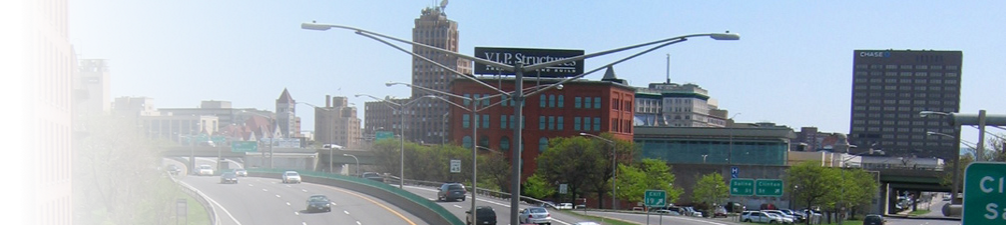
When I-81 was constructed in the 1950s and 1960s, highway design standards were different from today. Although the highway met the design standards of its era, I-81 does not meet current standards for high-speed freeways. This is true particularly in the urban sections, where physical constraints forced engineers to design the highway with tight curves, narrow lanes, short weaving distances, and minimal shoulders. In fact, this portion of I-81 has a speed limit of 45 mph, the lowest on the entire 850-mile corridor from Canada to Tennessee.

Operational Issues

The narrow width and high traffic volumes on the urban sections of I-81 pose significant operational challenges. It is difficult to conduct routine maintenance during daytime hours on I-81 in downtown Syracuse, as construction translates into major congestion. When accidents occur, limited shoulder width means that disabled vehicles are forced to remain in the travel lane, blocking traffic and creating additional hazards. Likewise, snow removal and stormwater runoff are recurring problems.


Interstate Bridge Conditions (1,291 kb; approx. download, 0h:3m:4s, 56k modem)

Structural Issues

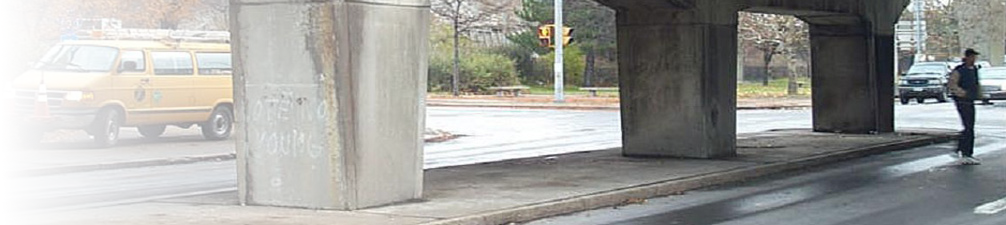
While The I-81 Challenge will study all of I-81 between the I-481 interchanges, the major reason for the urgency of this effort is the condition of the viaduct portion of I-81 in downtown Syracuse. Altogether, the viaduct has a total of 1.4 miles of bridges, with 124 individual bridge spans. The structures are approximately 50 years old and show signs of age and deterioration. NYSDOT frequently inspects these bridges and makes routine repairs to protect the traveling public. However, it is critically important to begin a serious effort to address these pieces of infrastructure to assure the safety and efficiency of the future regional transportation network.

Map at right: The deficiency ratings shown on this map indicate that many of the interstate bridges in the region are deficient in some aspects. The high number of deficient bridges is a reflection of the region’s aging infrastructure. NYSDOT routinely conducts bridge inspections and repairs to maintain a safe highway system. For example, they have a construction project under contract to address the single priority deficient bridge shown in the map. Still, the number of these aging structures indicates that it is time to begin a regional effort to plan for the future of our interstate system.

Fact Sheets

  • Fact Sheet #1: Summer 2009

    
		Fact Sheet #1: Summer 2009
    • Complete Fact Sheet, full spread

      • Low-resolution file for web viewing (731 kb; approx. download, 0h:1m:44s, 56k modem)
      • High-resolution file for printing (5,230 kb; approx. download, 0h:12m:23s, 56k modem)
    • Fact Sheet optimized for printing (8.5"x11" pages)

      • Low-resolution file for web viewing (836 kb; approx. download, 0h:1m:59s, 56k modem)
      • High-resolution file for printing (5,886 kb; approx. download, 0h:13m:57s, 56k modem)